
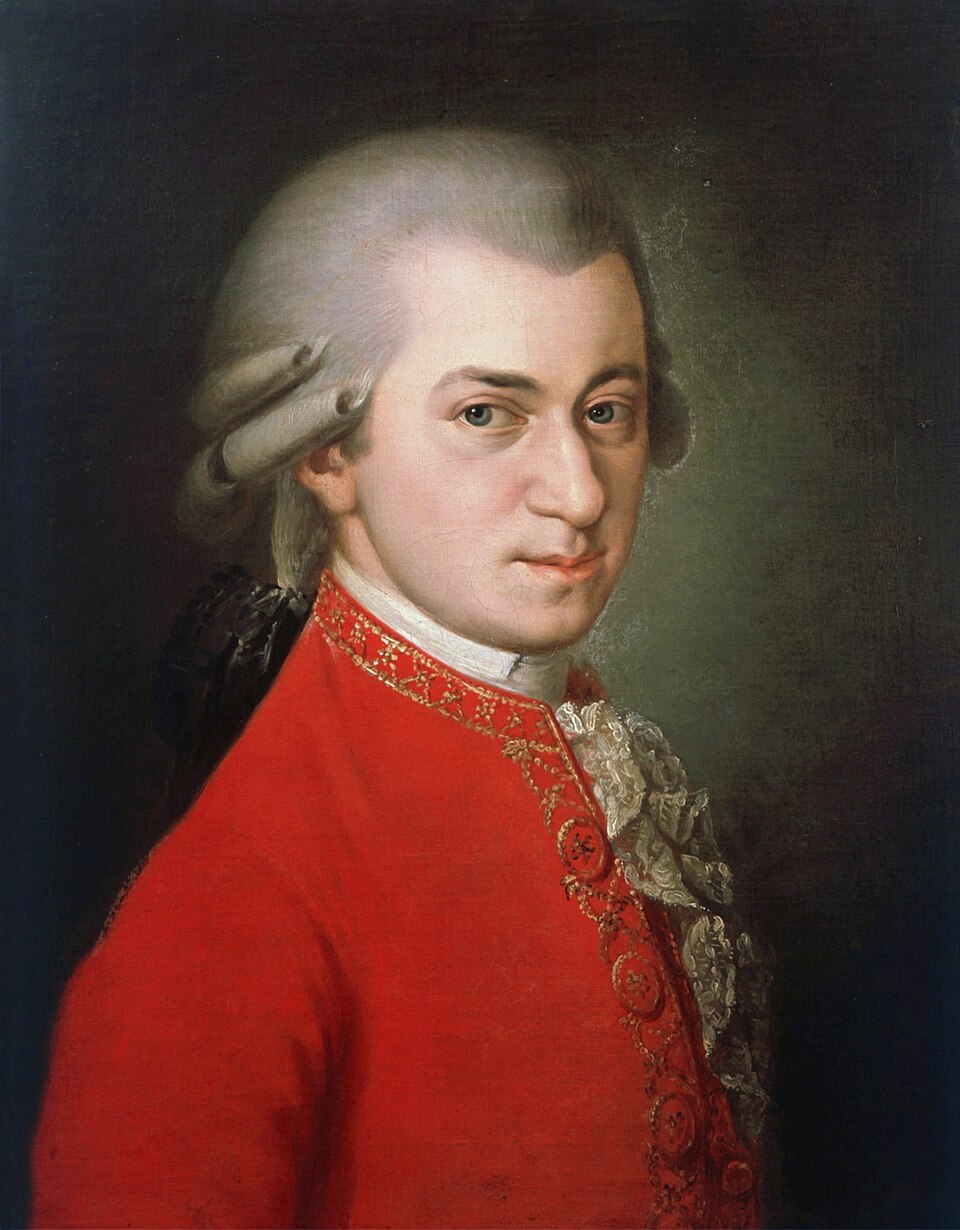
Wolfgang Amadeus Mozart was born on 27 January 1756 in Salzburg, then part of the Holy Roman Empire, to Leopold Mozart, a respected court musician and composer, and his wife Anna Maria. From the earliest age, it was apparent that the child was no ordinary musical talent. By the age of three he could pick out thirds on a harpsichord; by four he was learning minuets; by five he was composing short pieces. His father, recognising the staggering potential before him, dedicated himself almost entirely to his son's education, soon taking the prodigy — along with his equally gifted elder sister Maria Anna, known as Nannerl — on a series of tours across Europe that would shape the young composer's musical imagination indelibly.
Between 1763 and 1773, the Mozart children performed before the crowned heads of Europe. They played for Empress Maria Theresa in Vienna, for King Louis XV at Versailles, and for King George III in London. In London, Mozart encountered Johann Christian Bach, the youngest son of Johann Sebastian Bach, whose elegant, song-like style left a lasting impression on the boy's developing aesthetic. In Italy, he absorbed the warmth and vocal fluency of the operatic tradition. These years of ceaseless travel amounted to the most extraordinary musical education imaginable: a grand tour not merely of geography but of style, taste, and technique.
Returning to Salzburg, Mozart found himself increasingly chafed by the constraints of provincial court life and by his difficult relationship with his employer, the Archbishop Hieronymus Colloredo. The Archbishop viewed music as functional entertainment, not art; Mozart viewed himself as an artist of the first rank deserving of a grander stage. After a humiliating dismissal in 1781 — reportedly accompanied by a literal kick to the seat of the trousers — Mozart moved to Vienna, determined to forge a freelance career in the imperial capital.
Vienna proved both triumphant and precarious. His marriage to Constanze Weber in 1782 was happy by most accounts, though financially turbulent. The early Viennese years brought genuine celebrity: successful operas, packed subscription concerts, admiring patrons, and the profound friendship of Joseph Haydn, who told Leopold Mozart that Wolfgang was "the greatest composer known to me." Yet by the late 1780s the picture had darkened. Shifts in Viennese taste, the disruptions of the Napoleonic wars, and Mozart's own disregard for financial prudence meant increasing poverty. He wrote begging letters to his friend Michael Puchberg; his health declined; commissions became harder to secure.
Mozart died on 5 December 1791, aged just thirty-five, leaving his final work — the Requiem in D minor — unfinished. The cause of death remains debated: rheumatic fever, kidney disease, and various other diagnoses have been proposed. He was buried in a common grave, in accordance with Viennese custom at the time, not as the sign of obscurity that myth has sometimes suggested. He left behind a catalogue of over six hundred works and a legacy that would define Western music for centuries.
Week 1: The Classical era - the 18th century
Week 2: Chamber music
Week 3: The concerto
Week 4: The Symphony
Week 5: Opera
Week 6: Sacred music
Mozart's importance in the history of Western classical music cannot be under estimated: although he worked entirely within the conventions of his age, few composers before or since have so completely exhausted those conventions' expressive possibilities. He did not invent sonata form, the symphony, the piano concerto, or opera. What he did was reveal, with definitive clarity, what those forms were capable of at their best and most sublime. To study Mozart is, in a very real sense, to study the Classical ideal itself.
His historical significance is threefold. First, he helped establish the expressive range of purely instrumental music. Before Mozart, (and Haydn) there was genuine uncertainty about whether music without words could carry deep human meaning. His symphonies and concertos demonstrated that it could — that formal argument and tonal drama were capable of the same psychological complexity as language. This conviction would sustain Beethoven, Brahms, and the entire tradition of European absolute music.
Second, his operas transformed what drama could be. By giving each character music that is psychologically individuated — music that reveals inner life rather than merely illustrating external action — he redefined the relationship between composer and librettist, and between music and theatre. Wagner, Verdi, and every opera composer after him worked in his shadow.
Third, and perhaps most intangibly, Mozart set an ethical standard for the art: that beauty and truth must be inseparable, that craft must be worn lightly, and that the most profound emotions are best expressed with clarity rather than excess. In an art form perpetually tempted by grandiosity, his example remains a corrective, a reminder that perfection is not a matter of scale but of proportion, intelligence, and heart.
Choose a Subscription that suits you
An Annual Subscription
Gives you access to all videos, resources live and recorded courses on the site for 12 months from the date of purchase.
Courses: Live courses (on ZOOM) are held 3 times a year - in September, January and June. Each course consists of six, 90 minute sessions held on a Wednesday evening at 7.30pm (UK time). The sessions are recorded and edited into a video which is uploaded to the site, usually within a week. If you miss a session, you will be able to catch up by watching the recorded video in your own time. Some people prefer not to attend the LIVE sessions and just watch the recorded videos.
Videos: The Thinking Arts website has a growing catalogue of videos (currently 50+) which you will be able to access at any time. The videos are usually about 90 minutes long and cover a wide range of subjects - music history, chamber music, vocal music, the concerto, the symphony, contemporary music and many more.