
Listening and Hearing are not the same thing.
We are surrounded by sound from our first awakening to the moment we fall into sleep, but most of us don't really listen. When you woke up this morning, what were the first sounds you heard? Did you notice? Perhaps it was a bird singing outside or the clatter of tea cups in the kitchen? Or maybe just the sound of your breathing...
And if you did notice, how did you listen? Sound is a multi-dimensional phenomenon - it occupies space, has dynamics and duration, timbre, pitch (although not always) and it moves through time. There is a lot to notice.
This course is slightly different in content to the ones we have done before - there will still be lots of beautiful and wonderful music to listen to, but rather than focusing on one genre of music from the Classical repertoire, it will focus on 'How to Listen' seen through the prism of the building blocks which make up a musical experience together with techniques to stay present and engaged.
We will cover all sorts of topics that are related - how sound works, how we experience it and the effect it has on us, how we listen, music theory (no prior knowledge needed), melody, harmony, colour and musical structures. There will be a series of aural exercises which you can experiment with if you wish following the sessions.
Listening well takes practise, but first you need the why and the how. Taking part in this course results in an enhanced listening experience with more depth, focus and aural mindfulness.
Dates: October 21st, 28th, November 4th, 11th, 18th and 24th
Format: All LIVE classes are on ZOOM. Once you have subscribed, you will given a ZOOM link for the live course as well as access to over 50 videos on the website.
If you need to miss a session during the course, a video of the content from that week will be available on the website after a few days.
Week 1: How to Listen and How Sound Works
Week 2: How to listen: Sound Colour
Week 3: How to listen: Melody
Week 4: How to listen: Harmony
Week 5: How to Listen: Rhythm
Week 6: How to listen: Musical Structures
How to Listen and How sounds Work
Most of the listening any of us do happens in the background. Music plays while we cook, commute, work, or scroll, and it fits neatly around whatever else is actually holding our attention. There's nothing wrong with that, it's most of how music lives in an ordinary life. But it's a fundamentally different activity from foreground listening, giving a sound your full, undivided attention while it's actually happening. Almost everything this course goes on to teach, colour, melody, harmony, structure, depends on that second kind of attention, and most of us have simply never been taught how to practise it.
The reason foreground listening feels difficult isn't a personal failing. Human attention evolved to notice change and then move on, an efficient survival strategy, and almost everything about modern life reinforces exactly that pattern: notifications, multitasking, constant low-grade partial focus spread across several things at once. Sustained, undivided attention to a single sound has become a skill that requires deliberate practice, because nothing about a typical day encourages it by accident anymore.
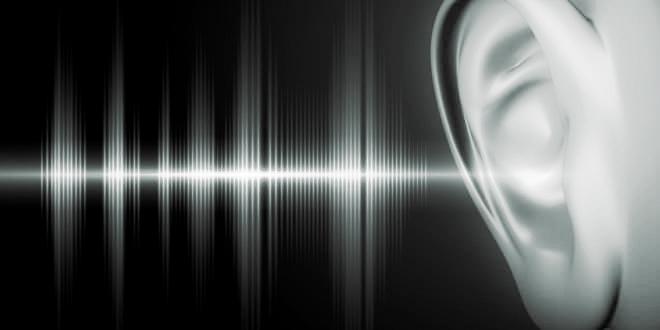
Listening and Hearing are not the same thing. We need to be able to hear in order to listen, but we spend most of our lives hearing without listening.
We are surrounded by sound from our first wakening moments to the moment we fall into sleep but we are not really present with the sounds that surround us. When you woke up this morning, what were the first sounds you heard? Did you notice? Perhaps it was a bird singing outside or the clatter of tea cups in the kitchen? Or maybe just the sound of your breathing...
In this first session we will explore these questions and offer ways in which to learn how to listen and really experience what that means.
How Sound Works
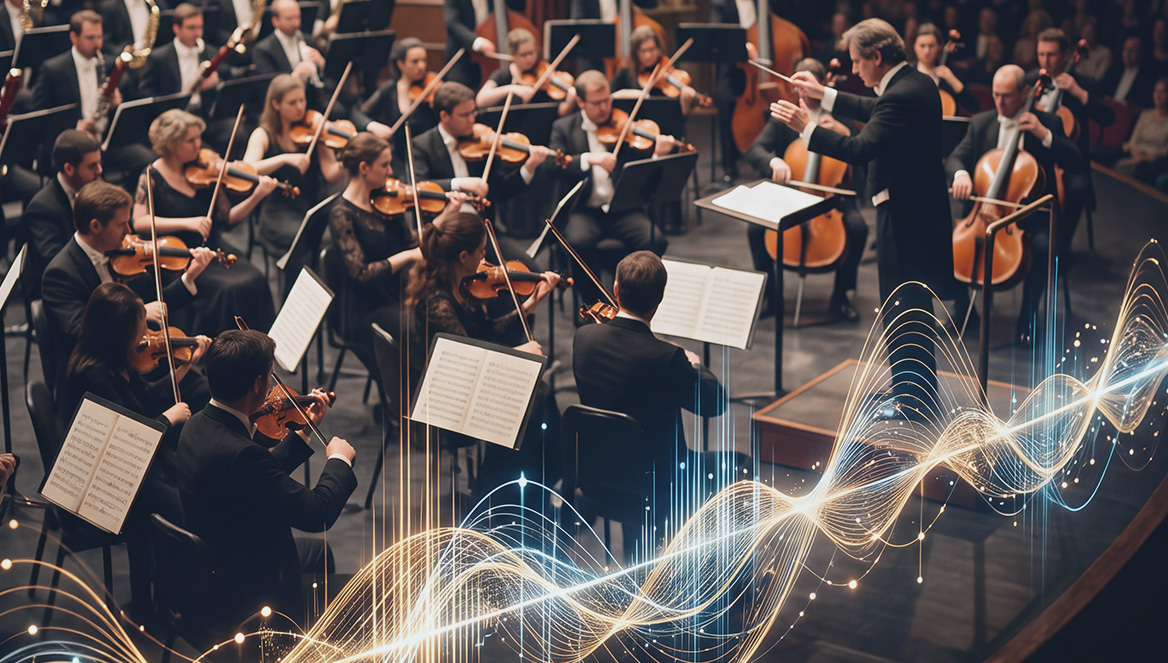
Sound begins with vibration. When any object moves back and forth rapidly, a plucked guitar string, a struck drum skin, a vibrating vocal fold, it pushes against the air molecules around it. Those molecules bump into their neighbours, which bump into theirs, and so on outward in every direction. This chain reaction of compression and rarefaction (squeezing together and spreading apart) is a sound wave. Nothing is actually travelling through the air except the disturbance itself: the individual air molecules mostly stay put, jostling back and forth, passing the energy along like a row of dominoes.
That wave eventually reaches your ear, where it sets your eardrum vibrating in sympathy. Three tiny bones in the middle ear amplify that motion and pass it to the cochlea, a fluid-filled spiral in the inner ear lined with thousands of hair cells. Different hair cells respond to different frequencies, converting the mechanical vibration into electrical signals your brain interprets as sound. Two physical properties of the wave shape almost everything we perceive. The first is frequency how many times per second the wave repeats, measured in Hertz (Hz). A faster vibration produces a higher frequency, which we hear as higher 'pitch'. Human hearing generally spans roughly 20 Hz to 20,000 Hz, though that upper range narrows with age. The second property is 'amplitude', how large the vibration is, essentially how forcefully the air is being pushed. Greater amplitude means more energy in the wave, which we perceive as greater loudness.
If frequency and amplitude were the whole story, though, every instrument playing the same note at the same volume would sound identical, and they plainly don't. A flute and a trumpet playing the same A are unmistakably different. That difference is timbre or tone colour, and it comes from a third factor: almost no real-world sound is a single pure frequency. A vibrating string or column of air actually vibrates simultaneously at many related frequencies: the fundamental (the lowest, which we perceive as the note's pitch) plus a whole family of higher overtones sitting at neat whole-number multiples of it, 2x, 3x, 4x, and onward.
This is the harmonic series, and every pitched sound contains it in some form. What varies between instruments, and what gives each its distinctive colour, is the relative strength of each overtone. A clarinet emphasises different rungs of the harmonic ladder than an oboe does; a "bright" sound has strong upper overtones, a "warm" or "dark" one has a stronger fundamental and weaker highs. Your ear is doing remarkably sophisticated work every time you casually describe a sound as "warm" or "harsh": it's parsing that whole hidden mixture of frequencies in real time, even though you're consciously aware only of a single note.
Sound, in short, is never as simple as "one note." It's a layered, physical event, vibration, wave, and a rich internal structure of overtones, arriving at an ear built specifically to unpack it.
Sound Colour
Sound colour, or timbre, is the quality that lets you tell a violin from a flute even when both play the exact same pitch at the exact same volume. It is the one property of sound that has nothing to do with which note is being played and everything to do with how that note is made.
In physical terms, colour comes from the harmonic series: every pitched sound is really a fundamental frequency plus a whole stack of overtones above it, and it is the relative strength of those overtones that gives a sound its particular character, bright, dark, warm, harsh, thin, rich. But colour is not just a physical accident. For a composer, it is an expressive tool used as deliberately as melody or harmony.
Choosing which instrument plays a line, and in which register, shapes the emotional weight of that line before a single interesting pitch has happened. A melody given to a solo clarinet in its low, reedy register feels intimate and a little mysterious. The same melody on a trumpet, high and bright, feels heroic or urgent. Nothing about the notes has changed, only the vehicle carrying them. Composers also combine colours the way a painter mixes pigments. Instruments can be blended together so closely that they merge into a single new sound, richer than any one of them alone, or they can be kept deliberately separate so that each retains its own identity and the contrast between them becomes part of the music's meaning. A solo oboe floating over quiet pizzicato strings is a very different statement from a full string section playing in unison. Both are colour choices, and both are choosing to say something different.
Performers shape colour too, often moment to moment. A string player changes bow pressure, speed, and position to move between a warm, singing tone and a thin, glassy one. A singer reshapes vowels and breath to move between a bright, forward sound and a darker, more covered one. In electronic and recorded music, colour becomes something sculpted directly, through synthesis, filtering, distortion, and effects, entirely independent of any acoustic instrument.
Learning to hear colour deliberately changes what you notice in almost any piece of music. Try isolating a single instrument or voice in a busy texture and following only it for twenty or thirty seconds. Try naming the quality of a sound, breathy, metallic, nasal, warm, before trying to name the instrument producing it. Notice whether colours around you are blending into one voice or being kept apart in contrast. And notice how often a shift in colour, a new instrument entering, a register change, a new vocal quality, marks a structural turning point in the music, sometimes more clearly than a change in harmony ever could. Once you start listening this way, colour stops being background detail and becomes one of the most expressive choices happening in the music at every moment.
Melody
A melody is the most familiar element in music, the thing most people mean when they talk about a tune. It is a sequence of pitches, organised in time, that we hear not as separate events but as a single connected line. What creates that sense of connection is shape.
If you plotted a melody's pitches against time, you would get a contour, a rising or falling line, and that shape alone carries enormous emotional weight before any harmony or rhythm is involved. A melody that leaps upward in a wide arc feels expansive or urgent. One that descends in small, even steps feels settled, even mournful.
Composers choose these shapes with the same intention a poet chooses the rhythm of a line. Melodies are built from phrases, sections roughly the length of a spoken sentence or a single breath, each with a sense of beginning, movement, and arrival. Many melodies work in pairs of phrases, an opening phrase that feels like a question, left open and unresolved, answered by a second phrase that feels settled and complete. This question and answer pattern, sometimes called antecedent and consequent, is one of the most common shapes in music across cultures and centuries, because it mirrors something close to how we naturally speak and breathe.
Within and across phrases, composers often work with a motif, a short, highly memorable fragment, sometimes only a handful of notes, that returns again and again through a piece in different guises. A motif might be stretched out, compressed, turned upside down, moved to a different pitch, or handed to a different instrument entirely, yet remain recognisably itself. Beethoven's opening four notes in his Fifth Symphony is probably the most famous example: a tiny idea that reappears, transformed, throughout the entire work. Catching a motif's return, especially when it has changed, is one of the most satisfying skills a listening ear can develop, because it reveals a level of structure that isn't obvious on a first, casual hearing.
Melody rarely exists alone. It sits on top of harmony, and the two constantly interact, a melody note can feel stable or unstable depending entirely on the chord beneath it, which is exactly where next week's listening picks up. But melody can also be followed on its own terms, purely as shape and phrase, independent of everything happening underneath it.
To listen for melody actively, try tracing its contour physically, with a hand in the air or just in your mind's eye, rather than only registering individual notes. Listen for the natural breath points where phrases pause and land. In denser music, follow a melody as it migrates between instruments, catching the handoff rather than losing the thread when the colour changes. And try singing or humming quietly along, even approximately, since physically producing a shape engages attention in a way passive listening rarely does. Once you start listening for shape rather than just notes, melody stops being background and becomes something you can genuinely follow, phrase by phrase, all the way through a piece.
Harmony
If melody is a horizontal line, moving through time note by note, harmony is what happens vertically, which pitches sound together at any given moment. Almost every combination of simultaneous pitches falls somewhere on a spectrum between consonance, a sound that feels settled, stable, and at rest, and dissonance, a sound that feels unsettled and wants to move somewhere else. Neither quality is good or bad on its own. They are tools, and the interplay between them, tension building through dissonance and release arriving through consonance, is one of the most powerful engines driving how music feels from moment to moment.
This push and pull operates at every scale. At the smallest level, a single dissonant chord followed by a consonant one creates a tiny arc of tension and release, often just a second or two long. Composers also build the same pattern across entire phrases, sections, or whole movements, setting up tension early and delaying its resolution for minutes at a time, or denying it altogether at a moment where the ear expected release, creating surprise or unease on purpose. A deceptive cadence, where the harmony moves somewhere unexpected right at the point resolution seemed guaranteed, is a classic example of a composer deliberately working against the ear's expectation for expressive effect.
How quickly the harmony changes also matters enormously, independent of tempo or melody. This is called harmonic rhythm. Music with fast-changing harmony tends to feel urgent, unstable, or driven, while music with slow or static harmony, sometimes staying on a single chord or drone for an extended stretch, tends to feel calm, suspended, or even hypnotic. Minimalist composers often exploit very slow harmonic rhythm deliberately, letting listeners settle into a kind of meditative stillness that faster harmonic movement would never allow.
Crucially, none of this requires knowing chord names or music theory to hear. Harmony is fundamentally a physical, felt experience before it is an intellectual one. A useful way to build this listening skill is to notice, quite literally, the sensation of wanting something to happen when a dissonant or unstable chord sounds, and to sit with that wanting for a moment rather than rushing past it toward the resolution. Tracking the bass line, the lowest note in the texture, is another highly effective technique, since the bass very often drives the sense of harmonic direction and destination even when the pitches above it are complex or busy.
Harmony and melody are deeply intertwined; the same melodic note can feel completely stable or completely tense depending entirely on which chord is sounding beneath it. Learning to hear harmony as its own expressive dimension, separate from but constantly interacting with melody, opens up a layer of music that is easy to feel intuitively but often goes completely unnoticed without deliberate attention.
Rhythm
Rhythm is how music organises time. It rests on a steady pulse, groups beats into patterns of strong and weak (metre), and lays patterns of long and short sounds over the top. Much of the excitement comes from playing against the pulse. Rhythm is the part of music your body already responds to, so learning to hear it means turning something you feel into something you can follow.
Many of the topics we have covered are reliant on rhythm - melody, harmony, musical structures and even colour are dependent on rhythm in a musical context.
In this session we explore rhythm from all these aspects.
Musical Structures
So far we've discussed colour, melody and harmony all of which happen moment to moment, within a phrase or a passage. Structure is the level above all of that, the overall architecture of an entire piece, how its sections are arranged, repeated, varied, and set against one another across several minutes or, say in a symphony, across an hour or more. It is the hardest musical element to hear consciously, because it requires holding a large stretch of time in memory at once, but it is also one of the most rewarding, because it reveals the composer's largest-scale intentions.
Structure is built from two basic, opposing forces: repetition and variation. Repetition, bringing back material we've already heard, creates familiarity, unity, and a sense of coming home. Variation, bringing that same material back changed in some way, creates interest, surprise, and forward motion. Almost every large-scale musical form is really just a particular balance of these two forces, arranged in a specific, recurring pattern.
Certain patterns recur so often, across centuries and across very different musical traditions, that we give them names. Ternary form, often written ABA, states an idea, moves away into contrasting material, then returns to the opening idea, a shape as old as it is satisfying. Sonata form, common in Classical and Romantic instrumental music, expands this same basic logic to a much larger scale: an exposition presents the main musical ideas, a development section pulls them apart and explores them under tension, and a recapitulation brings them back, now resolved. Verse-chorus form, the backbone of most popular music, alternates a narrative, changing verse with a stable, repeated chorus that anchors the listener. Theme and variations takes a single idea and restates it again and again, each time transformed in rhythm, harmony, colour, or character, while remaining recognisably itself.
Once a listener's ear has absorbed a piece's pattern, even within a single hearing, it begins to predict what should happen next. Composers know this and use it deliberately, sometimes satisfying the expectation for a sense of rightness and closure, sometimes subverting it, arriving somewhere unexpected, for surprise, humour, or dramatic weight. A return that arrives exactly on schedule feels different from one that is delayed, foreshortened, or denied altogether.
Listening for structure in practice means adopting a few simple habits. Give each new section a rough label as it arrives, even something as casual as 'the calm bit' or 'the loud bit', turning a long, continuous stream of sound into a sequence you can track and recall. Actively listen for the return of earlier material, and when it comes back varied, ask specifically what changed and what stayed constant, the rhythm, the harmony, the instrumentation, or the register. And zoom out further still to notice the overall pacing of an entire piece, whether it builds steadily toward one climax, alternates calm and intensity throughout, or chooses to end quietly rather than triumphantly. That large-scale shaping is itself one of the most powerful expressive choices a composer makes, and it is entirely audible once you know to listen for it.
Choose a Subscription that suits you
An Annual Subscription
Gives you access to all videos, resources live and recorded courses on the site for 12 months from the date of purchase.
Courses: Live courses (on ZOOM) are held 3 times a year - in September, January and June. Each course consists of six, 90 minute sessions held on a Wednesday evening at 7.30pm (UK time). The sessions are recorded and edited into a video which is uploaded to the site, usually within a week. If you miss a session, you will be able to catch up by watching the recorded video in your own time. Some people prefer not to attend the LIVE sessions and just watch the recorded videos.
Videos: The Thinking Arts website has a growing catalogue of videos (currently 50+) which you will be able to access at any time. The videos are usually about 90 minutes long and cover a wide range of subjects - music history, chamber music, vocal music, the concerto, the symphony, contemporary music and many more.